
Spotlight on Our Spool: Jill Kiernan of TBRS Community
A conversation with Jill Kiernan, Executive Director at TBRS Community, on how even small teams can run comprehensive end-of-year fundraising campaigns that incorporate several best practices.
TBRS Community supports families affected by Tatton Brown Rahman Syndrome, a rare genetic condition, through education, connection, and advocacy. In fall 2025, TBRS Community had just one full-time staff member (Jill) and a small group of dedicated volunteers lined up to support end-of-year (EOY) fundraising. TBRS Community set an ambitious goal for its 2025 EOY campaign: raise $60,000 to help launch the organization's first Center of Excellence. This goal was double the EOY fundraising campaign from the year prior. TBRS Community worked with Thread Strategies to create a comprehensive strategy that incorporated best practices for EOY fundraising campaigns. TBRS Community surpassed its goal, representing incredible growth over prior year. Total funds raised and total number of donors both were close to double prior year, and first-time donors grew by 68%. The campaign's impact didn't go unnoticed: TBRS Community and Thread Strategies won the 2026 Dynamic Duo Givie Award, presented at GiveCon, recognizing standout nonprofit-partner collaborations.
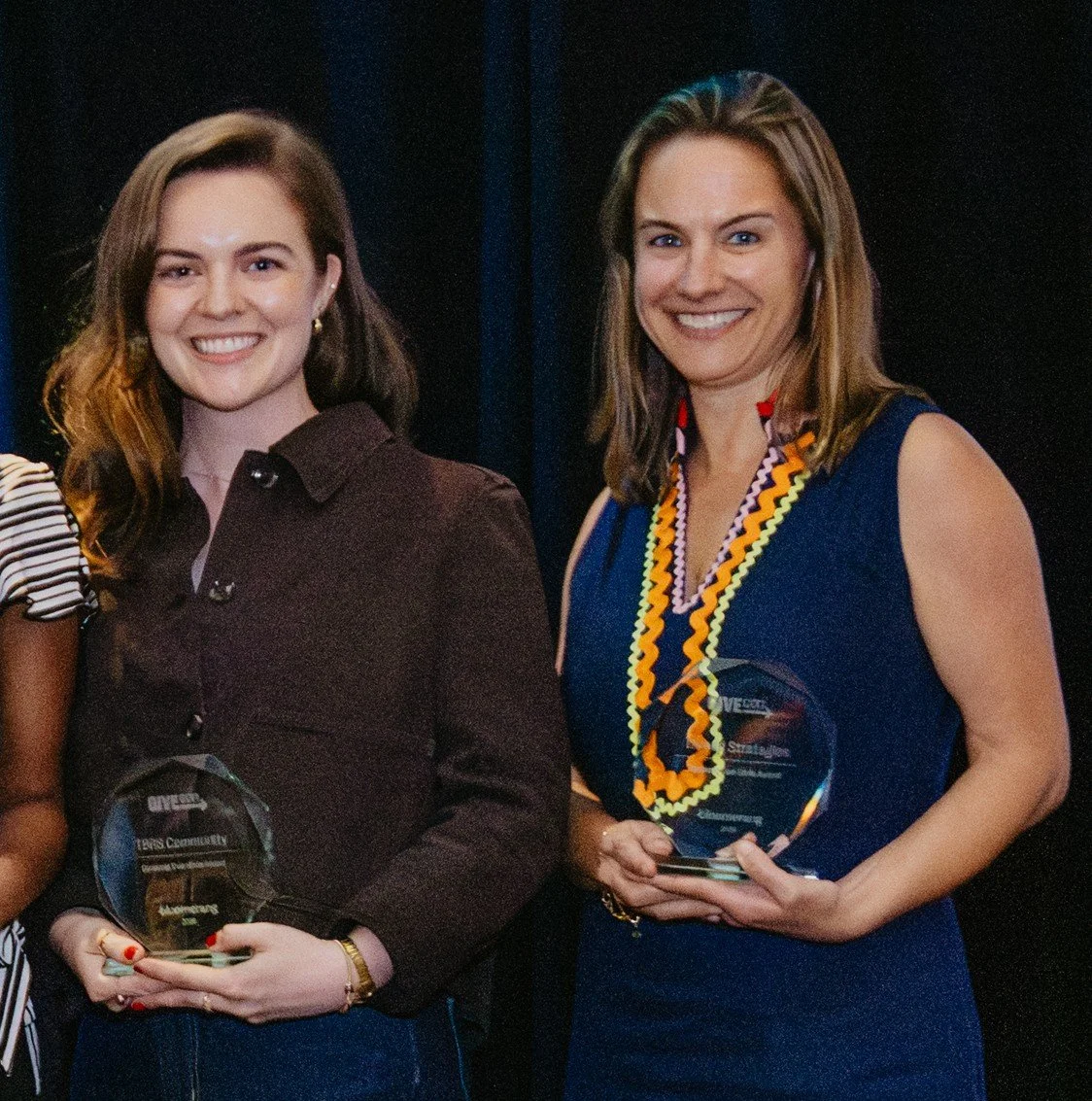
Róisín DeBonis, TBRS Community’s Development and Communications Manager, and Loree Lipstein, CEO & Founder of Thread Strategies, receive their award at GiveCon.
Thread: Walk us through where TBRS Community's fundraising stood before this campaign. What made you decide to approach year-end so differently in 2025?
Jill: Our year-end appeals in past years were pretty simple, a few emails that went to our full email list, without segmentation, and we sent a mailed letter. Our community is so supportive throughout the year, we felt confident we could do more at EOY, but it was hard to imagine stepping up our efforts with how split my time is in many directions as the only staff member working on fundraising. However, as we approached the end of 2025, we had a real reason to go bigger: we needed to raise $60,000 to help launch our first Center of Excellence in 2026, and that goal gave us the push to take our EOY campaign to the next level by incorporating more best practices into our strategy.
Thread: This campaign involved segmenting your donor list into eight different groups. What did that actually look like day to day for a small team, and was it worth the extra effort?
Jill: It sounds like a lot when you say “eight segments,” but in practice it was about being intentional with our community – which is less intimidating, since we spend time year-round getting to know our community well. We thought about how we would want to speak to various members of our community a bit differently, and created segments based on having slightly different approaches for various groups of people. Once the groups were set up as reports in our CRM, it was not hard to follow our specific communication plans for each segment. In fact, writing content that could speak to each group specifically was almost easier than trying to write one email that could work for everybody the same, since everyone is not the same. And it clearly worked. Our lapsed-donor outreach alone brought back dozens of people who hadn't given in over a year, and our outreach to donors who had already given a gift earlier in the year resulted in many repeat gifts that made up a significant portion of our overall total raised.
Thread: You ran email, direct mail, phone calls, and social media all at once, plus a peer-to-peer element. How did you keep all of that from feeling overwhelming?
Jill: Having a calendar mapped out ahead of time made the biggest difference — knowing exactly what was going out each week, on which channel, to which segment, meant I wasn't making decisions on the fly in December. The peer-to-peer piece, where families could claim a day on a giving calendar and fundraise within their own networks, was targeted to Giving Tuesday specifically, which helped to target those efforts amongst the broader campaign throughout December.
Thread: This campaign used matching gifts to drive urgency. How did that actually play out for you?
Jill: We didn't just have one matching gift, we had three separate matching moments throughout the campaign, funded by a mix of existing major donors and the board giving together as a group. Spacing them out like that meant we always had a fresh reason to create urgency as we stayed consistent with our overall storytelling to drive toward our ultimate goal. Each time we launched a new match, we saw a real jump in giving activity. All our communications performed better during those matching moments. Leveraging matching gifts ended up being one of the most important strategic elements of this year’s campaign.
Thread: Now that you've run a campaign like this, what would you tell another small nonprofit team who's intimidated by the idea of putting together a year-end appeal with this many strategic elements?
Jill: Start with the plan, not the tactics. Once we had a goal, our core case for support, and knew our audience, we could put together a real calendar and operational plan to make it all happen. The actual execution wasn't as overwhelming as I expected for a campaign of this magnitude when we had it all mapped out and prepared in advance. And that’s another important factor – start EARLY, so you have time to work through all the elements BEFORE the campaign fully launches. It would have been near impossible to build the campaign while also trying to drive all the elements forward. But by building the full strategy and all the communications in advance, I could then focus on just making them all happen according to the calendar once it was time.
You also don't need eight segments and five channels on day one. If you’ve never segmented your communications, just try splitting your list into two or three groups to start. And if you’ve only ever used email, try adding one extra touchpoint beyond email will make a real difference. The most important element for us is that we had a plan, and that it was a realistic plan that we could actually follow. Whatever realistic means for you, that’s the place to start.
Thread: What's different about how you'll approach year-end fundraising for 2026?
Jill: We're not starting from scratch, rather, we’re continuing to build on our efforts from last year. It’s mid-August, and we’re already starting to put together our strategy. Starting from where we left off last year, we’re evaluating what segments we’ll use this year, determining what our core case for support will be, and iterating on the messaging calendar we had last year. Everything we did last year was documented in a strategy and then evaluated in a wrap-up report. We’re using those materials to keep building, rather than feeling like we’re starting this annual strategy over each year. And really, that's the part I'm most excited about. This year doesn't have to be a heroic effort, it can just be running the playbook we’ve developed already and making it better.
Want to learn more about planning a year-end campaign for your own small team? Reach out to Thread.