
I Wanted To Get Bored
Executive Principal Taryn Deaton reflects on a month of rest that reshaped her capacity for leadership — and why nonprofit effectiveness starts with real recovery

Taryn ringing in the new year at the Avett Brothers concert.
I started 2026 at an Avett Brothers concert in Asheville, North Carolina (super fun—they do it every year, and you should absolutely go). After the ball dropped and we sang Auld Lang Syne, the band launched into a cover of “Centerfield” by John Fogerty. When they hit the line “Put me in, coach,” it struck a chord—not just because I’m a baseball fan desperate for the 2026 season.
I had coasted into the holidays on fumes. I was exhausted, and I was overwhelmed and dispirited by what is happening in the world. Standing there in that moment, it became clear that this song was offering me my marching orders for the year ahead. The rest I’d taken after Christmas had returned just enough energy for me to realize: I wanted to get back in the game—but not the way I had been playing it.
It’s hard to describe the times we’re living in. Every word feels insufficient. But what I know for sure is that the last year and a half has been incredibly hard on nonprofit organizations and their leaders. Ours is a sector that has always been under-resourced and under-supported. Now, funding cutbacks have led to layoffs, community needs are growing, and the capacity to meet those needs is shrinking. The pressure on an already burnout-prone workforce is immense.
Burnout is, unfortunately, a common experience in nonprofit work. As a consultant, I regularly support development and nonprofit leaders who are stretched far beyond capacity. I often joke that in more than 25 years of nonprofit work, I’ve never met a nonprofit leader who had extra time lying around. The to-do lists are long. The resources are short.
After 20 years working inside nonprofit organizations, I joined the Thread Strategies team in September 2019. Since then, I’ve had the opportunity to support dozens of organizations and what has always driven me—the common thread, if you will—is the relationships: with partners, colleagues, and leaders doing deeply meaningful work under incredibly challenging conditions.
While the demands of fundraising consulting are different from being an in-house fundraiser, the strain is real. Juggling the needs and priorities of multiple partners, striving to be fully present, and holding the emotional weight of the work takes a toll—especially for an introvert like me.
Several years ago, Thread’s leadership team made the decision to implement a sabbatical policy for all full-time staff. After five years, team members are eligible for a one-month sabbatical. In August 2025—at a point when I truly didn’t have much left to give to my clients, colleagues, family, or friends—I took mine.
Unlike my friend Kirra Jarratt (whose beautiful reflection on her own sabbatical I highly recommend), I was not terribly intentional in planning mine. Circumstances didn’t really allow for it. I was exhausted, and the last thing I wanted to do was plan another thing.
Coming from backgrounds in higher education and religious life, I had absorbed the idea that sabbaticals were meant to be productive. Professors researched. Pastors studied. Institutions often required a plan: What would you accomplish? What would you produce?
As my sabbatical approached, I felt an internal pressure to do something meaningful with the time. But I simply didn’t have the mental capacity to imagine it. After fighting myself for a while, I finally listened more closely—and what I wanted became very clear.
I wanted to get bored.
Like many nonprofit leaders, I live with a constant sense of responsibility. There is always something that needs attention, personally or professionally. During my sabbatical, I didn’t want to feel responsible for anything—or for anyone.
I want to acknowledge that this was possible for me because of privilege, resources, and support. I’m not a parent or caregiver, and I have a husband who encourages me to take time for myself. I recognize that “getting bored” may not be possible—or desirable—for everyone.
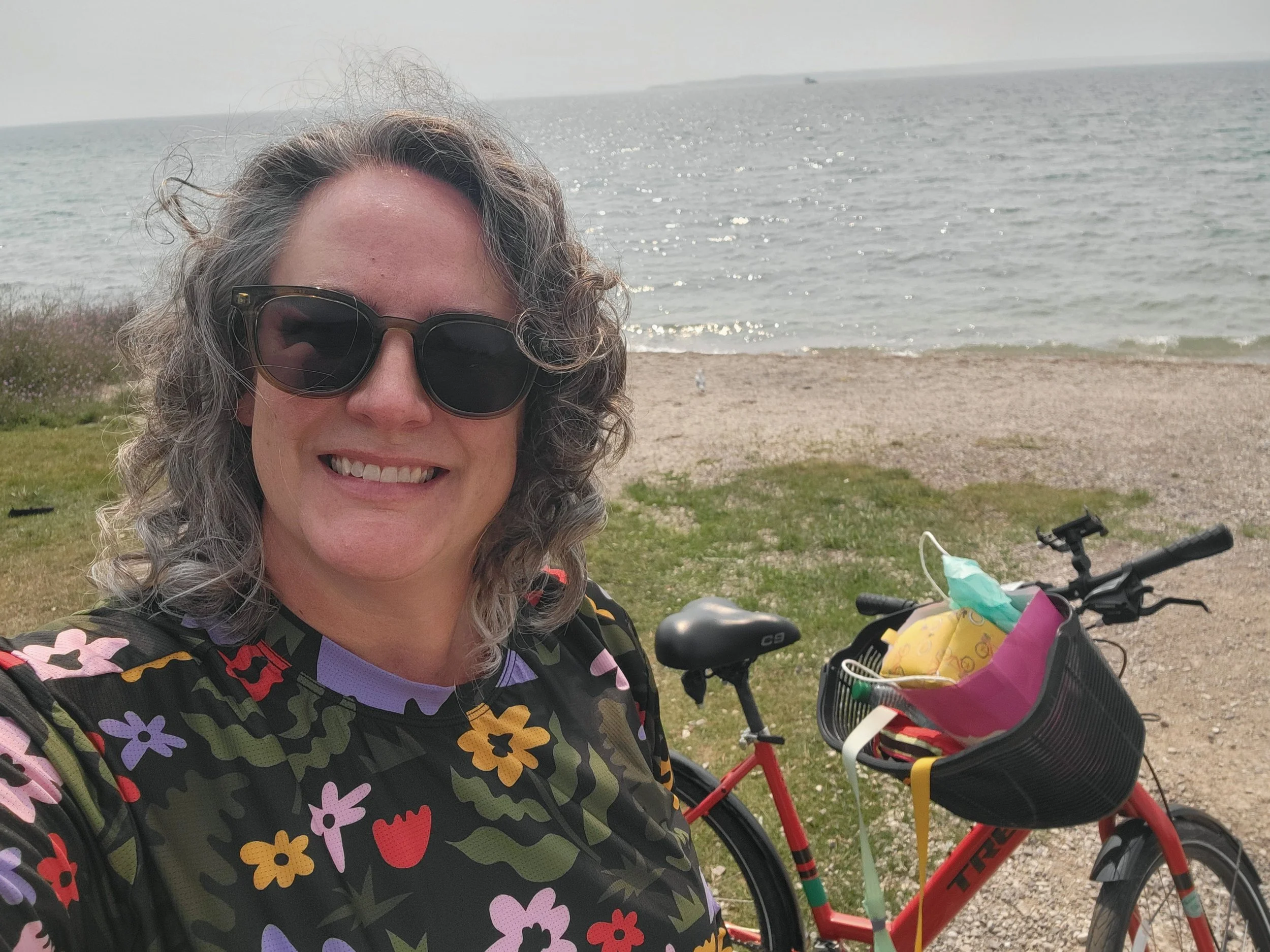
Taryn enjoying a day bike riding on Mackinac Island, MI.
A big part of making it possible for me was physically removing myself from my home. For several years, I’ve spent time each summer in northwest Michigan to escape the chaos (and swampy heat) of Washington, DC. It’s familiar, grounding, and a place where I can let go.
So I spent more than four weeks in Michigan doing exactly what I needed: sleeping a lot, riding my bike, going to the beach, practicing restorative yoga, eating good food (and a lot of ice cream), listening to trashy audiobooks, and—often—lying on the couch watching bad TV. I spent most of the time alone, though my husband joined me for part of it.
It was exactly what I needed.
It took time to come down from months of pushing hard. But eventually, I slowed. I noticed my surroundings. I did things that actually filled my cup. And as my return to work approached in late August, something surprising happened—I felt excited to come back.
My capacity to be present had expanded. I no longer experienced every request as a burden. I remembered why I care so deeply about this work and the people who do it.
I studied theology in graduate school, focusing on Christian ethics. We often talked about how leaders of social justice movements sustained themselves in the face of violence, despair, setbacks, and loss. In my faith tradition, we call these spiritual disciplines. At their core, they are practices of intentional rest and community support.
The pressures nonprofit leaders face right now are significant—and they are not going away anytime soon. If we want to stay in this work for the long haul, we have to take sustainability seriously.
If you’re feeling burned out, it may be time to talk with your organization’s leadership about a sabbatical. And if that’s not possible, finding daily practices—like those my colleague Erica Baca describes—that create moments of rest, grounding, and perspective is essential.
Pulling back when the need feels so great may seem counterintuitive. But the truth is this: no one person can carry an organization. And rested leaders make better decisions—for themselves, their teams, and the missions they serve.
The challenges facing our sector are real, urgent, and heavy. But burning ourselves out will not solve them. We can’t affect system change and build healthy organizations on exhausted people. Whether through a sabbatical, daily practices of rest, or a community that helps carry the load, we must choose to care for ourselves with the same seriousness we bring to our missions. When we do, we don’t step away from the work—we ensure we can stay in it.